Generative AI Training
Become a job-ready Generative AI professional. Learn LLM fundamentals, prompt engineering, RAG with vector databases and agent-based app building through hands-on projects using real OpenAI/Anthropic APIs — with placement assistance.
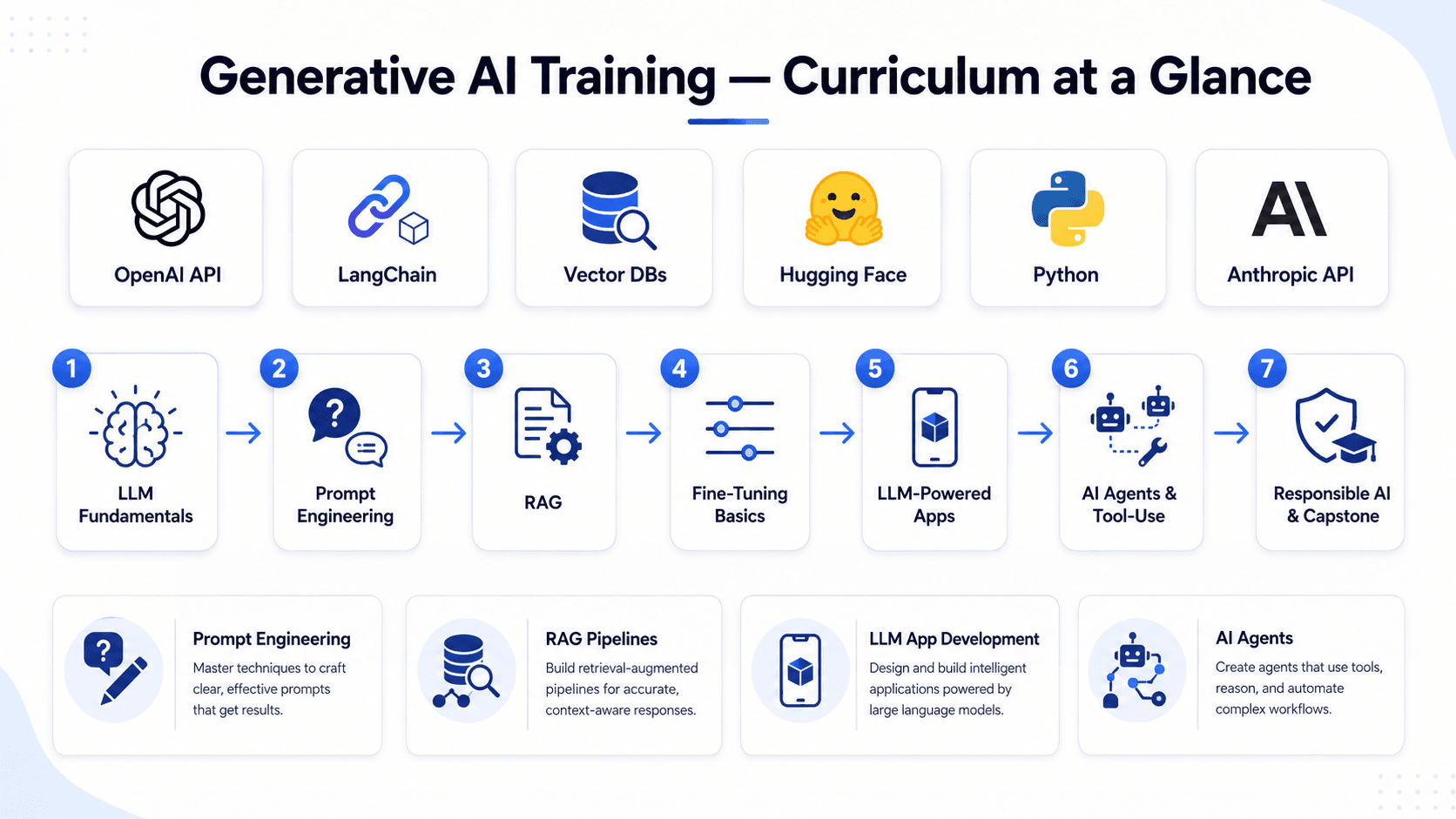
What you learn in this Generative AI course
Generative AI, powered by large language models, has moved from research labs into everyday products — copilots, chatbots, document assistants and autonomous agents. Organisations across every sector are hiring for the ability to design prompts, build retrieval-augmented systems and ship LLM-powered applications, making GenAI one of the fastest-growing skill areas in tech.
This course takes you from transformer and LLM fundamentals to building real applications. You will practice prompt engineering techniques, build Retrieval-Augmented Generation (RAG) systems with vector databases, explore fine-tuning basics, build apps using LangChain-style frameworks, and design AI agents that use tools. Every concept is reinforced with lab work using real OpenAI and Anthropic APIs so you leave with working, demonstrable projects.
Why Generative AI skills are in demand
Rapid enterprise adoption of LLM-powered products is driving very high demand for GenAI-skilled professionals.
Enterprise LLM Adoption
Companies are embedding copilots, chatbots and document assistants into products, creating strong demand for GenAI app builders.
RAG & Agents Everywhere
Retrieval-augmented generation and tool-using agents are becoming standard architecture, requiring practical, hands-on skills.
Fast-Growing, High-Paying Field
GenAI roles command premium salaries as the talent pool with real, applied experience remains limited relative to demand.
Roles and earning potential
Indicative role titles and market salary ranges in India. Actual packages depend on experience, location and employer.
| Role | Experience | Indicative Salary (India, per year)* |
|---|---|---|
| Prompt Engineer | 0–2 yrs | ₹5–9 LPA |
| AI/ML Engineer (GenAI focus) | 2–5 yrs | ₹10–20 LPA |
| GenAI Application Developer | 2–5 yrs | ₹12–22 LPA |
| GenAI Solutions Architect | 6+ yrs | ₹28 LPA+ |
*Ranges are general market indicators compiled from public job data, not a guarantee of placement or salary.
Detailed Generative AI curriculum
Structured modules that build from LLM fundamentals to full agentic application delivery.
Week 1 LLM Fundamentals & Transformer Architecture
- How transformers and attention mechanisms work
- Tokens, embeddings and context windows
- Overview of major LLM families (GPT, Claude, open-source models)
- Setting up an API-based development environment
Week 2 Prompt Engineering
- Zero-shot, few-shot and chain-of-thought prompting
- System prompts and role design
- Structured outputs and prompt templates
- Evaluating and iterating on prompts
Week 3 Retrieval-Augmented Generation (RAG)
- Embeddings and vector similarity search
- Vector databases (Pinecone, FAISS) setup
- Building a RAG pipeline for document Q&A
- Chunking strategies and retrieval tuning
Week 4 Fine-Tuning Basics
- When to fine-tune vs prompt vs RAG
- Preparing datasets for fine-tuning
- Fine-tuning workflow overview
- Evaluating fine-tuned model performance
Week 5 Building LLM-Powered Apps
- LangChain-style framework fundamentals
- Chains, memory and orchestration patterns
- Connecting LLMs to external data and tools
- Building a chatbot/assistant end to end
Week 6 AI Agents & Tool-Use
- Agent architectures and reasoning loops
- Tool/function calling with OpenAI and Anthropic APIs
- Multi-step task planning and execution
- Building a working AI agent project
Week 7 Responsible AI & Capstone
- Guardrails, hallucination mitigation and safety basics
- Cost, latency and API usage considerations
- Capstone: end-to-end GenAI application
- Portfolio and interview preparation
Technologies and tools you will use
Projects you will build
- Prompt-engineered assistant: a task-specific chatbot with structured outputs and evaluation.
- RAG document Q&A system: a retrieval pipeline over real documents using a vector database.
- Capstone: an end-to-end AI agent that uses tools to complete multi-step tasks.
- Software developers wanting to build LLM-powered applications
- Data scientists and ML engineers moving into GenAI
- Graduates targeting Prompt Engineer / GenAI Developer roles
- Prerequisites: basic Python is helpful; deep ML theory is not required as fundamentals are covered
Certification & Portfolio Readiness
Curriculum covers core skills assessed in industry-recognised GenAI and prompt engineering certifications, plus you graduate with a portfolio of working LLM applications to showcase to employers.
Placement Assistance
Resume building, Generative AI interview questions, mock interviews, LinkedIn optimisation and referrals to hiring partners as part of our placement support.
Related technology courses& resources
Cloud Computing & DevOps →
Become a job-ready cloud and DevOps professional. Learn AWS,…
Cyber Security →
Become a job-ready security professional. Learn network secu…
Data Science →
Become a job-ready data professional. Learn Python, statisti…
Full Stack Web Development →
Become a job-ready full stack developer. Learn HTML/CSS/Java…
Start your Generative AI journey
Contact our admissions team for the syllabus, next batch dates and a free counselling session.
Generative AI Training — Frequently Asked Questions
What is Generative AI?
Generative AI refers to models, largely built on transformer architectures, that generate text, code, images and other content. Large Language Models (LLMs) like GPT and Claude power chatbots, coding assistants and document-processing applications used across industries.
Who should take the Generative AI course?
Software developers, data scientists, product folks and graduates who want to build LLM-powered applications, work with AI agents or move into GenAI-focused roles. Basic Python familiarity is helpful.
Do I need a machine learning background to learn Generative AI?
No. The course starts with LLM and transformer fundamentals in plain terms. Basic Python programming knowledge is useful, but deep ML theory is not required as core concepts are taught from the ground up.
How long is the Generative AI training?
The core program typically runs 6 to 8 weeks with instructor-led sessions, hands-on labs and a capstone project. Exact duration depends on the batch mode and pace.
Is the Generative AI training available online and classroom?
Yes. Placeonix offers both instructor-led classroom training in Hyderabad and live online sessions, so you can choose the format that fits your schedule.
Will I build real applications with LLM APIs?
Yes. Labs use real OpenAI and Anthropic APIs so you build working applications — chatbots, RAG systems and agents — rather than only studying theory.
What topics are covered in the Generative AI curriculum?
LLM fundamentals and transformer architecture basics, prompt engineering techniques, Retrieval-Augmented Generation (RAG) with vector databases, fine-tuning basics, building apps with LangChain-style frameworks, AI agents and tool-use, OpenAI/Anthropic APIs, and responsible AI/guardrails.
Which tools and technologies will I use?
OpenAI API, Anthropic API, LangChain, vector databases such as Pinecone and FAISS, Hugging Face and Python.
Are there hands-on projects?
Yes. You build a prompt-engineered chatbot, a RAG-based document Q&A system with a vector database, and an AI agent that uses tools, so you finish with portfolio-ready LLM applications.
Does this course prepare me for Generative AI certifications?
The curriculum covers core skills assessed in industry-recognised GenAI and prompt engineering certifications. Trainers provide guidance on relevant certification paths and a project portfolio for job readiness.
What job roles can I target after Generative AI training?
Prompt Engineer, GenAI/AI Application Developer, AI/ML Engineer, LLM Solutions Architect and AI Product/Automation roles.
Is Generative AI in demand?
Yes. Enterprises are rapidly adopting LLM-powered features, copilots and agents, making Generative AI skills one of the fastest-growing and highest-demand areas in tech today.
Do you provide placement assistance for Generative AI?
Yes. Placeonix provides placement assistance including resume building, mock interviews, interview questions, LinkedIn optimisation and referrals to hiring partners.
What is the batch size?
Batches are kept small (maximum 30) so every learner gets individual attention and direct trainer feedback.
Can working professionals join?
Yes. Weekend and evening batches are available so working professionals can upskill without a career break.
Will I get a course completion certificate?
Yes. You receive a Placeonix course completion certificate along with a portfolio of working LLM applications.
How is Generative AI different from Data Science?
Data Science covers the broader toolkit of statistics, analysis and traditional machine learning, while Generative AI focuses specifically on large language models, prompting, RAG and agent-based applications built on top of foundation models.
What is the fee for the Generative AI course?
Fees vary by batch, mode and any combo package. Contact the Placeonix admissions team for the current Generative AI course fee and available offers.
Do you offer combo packages with Data Science?
Yes. A Data Science + Generative AI combo is available for learners who want end-to-end coverage from analytics to LLM applications, at a bundled price. Ask admissions for details.
Where is the Generative AI training centre located?
Placeonix is located at Kapil Kavuri Hub, No. 144, 9th Floor, 152, Financial District, Hyderabad, Telangana 500032. Online training is available across India.
How do I enrol in the Generative AI course?
Submit an enquiry on this page or call +91 99494 94020 / +91 91217 59191. The team will share the syllabus, next batch dates and a free counselling session.